
Prefer to watch? Here's this weekend's video update.
The Week in Review
The S&P 500 just had its worst week since the April 2025 tariff crash. It is officially in a correction, and the Nasdaq has given back all of its 2026 gains.
SPX closed at 6,910.39, down 651 points (8.61%), after seven straight losing sessions, the first seven-day run since February 2020. Friday alone cost 266 points and took the index below 7,000 for the first time since April 15. SPX now sits 11.6% below its October 6 record close of 7,818.93 and 65 points above where 2026 began. The Nasdaq Composite fell 10.02% to 22,617.73. The Russell 2000 fell 7.48% to 2,581.79, the smallest loss of the three.
VIX closed at 35.89, up from 19.30, its highest close since late March. The 10-year Treasury yield fell to 4.92% from 5.15%.
Weekly Market Scorecard — Week Ending November 20, 2026
| Index | Nov 13 Close | Nov 20 Close | Change | % Change |
|---|---|---|---|---|
| SPX | 7,561.67 | 6,910.39 | -651.28 | -8.61% ↓ |
| Nasdaq Composite | 25,136.27 | 22,617.73 | -2,518.54 | -10.02% ↓ |
| Russell 2000 | 2,790.49 | 2,581.79 | -208.70 | -7.48% ↓ |
Other closes: VIX 35.89 (from 19.30), 10-year 4.92% (from 5.15%), 2-year 4.63% (from 4.88%), WTI $83.62 (from $88.56), Brent $92.57 (from $95.84), gold futures about $3,539 (from about $3,886), a 14.5-month low.
Nvidia Beat, Then Broke
Nvidia reported on Tuesday: revenue of $115.8 billion, earnings of $2.68 a share against $2.47 expected, and fourth-quarter guidance of $130 billion. The stock fell three days in a row anyway, then lost 14% on Friday to $125.53 after Reuters reported that SEC enforcement staff are reviewing potential accounting issues. It fell 22.9% for the week, its worst week since October 2008. The semiconductor index dropped 10.7% on Friday, with all 30 members down.
The Biggest IPO Ever Couldn't Stop the Selling
Anthropic priced its IPO at $83 on Wednesday night, above the expected range, raising a record $107.3 billion. It closed its first day at $97.17, up 17.1%, but the S&P 500 still lost 148 points that day with more than 90% of its stocks lower. On Friday Anthropic fell 8.5% to $88.91. Steve's take in the video: a company he'd like to own, but not at these prices.
The Fed Leans Toward a Hike. Bonds Rallied Anyway.
The minutes of the October Fed meeting showed nearly all officials expect a quarter-point hike in December, and two floated a half-point. A December 9 hike is priced at roughly 90% to 95%, depending on the measure. Yet the 10-year yield fell 23 basis points this week as money moved into bonds.
The data was mixed. October retail sales rose 0.2%, and the control group rose 0.6% against 0.3% expected. The Philadelphia Fed manufacturing index fell to 6.3 against 20.0 expected, while its prices-paid index jumped to 58.2 from 43.2. Weekly jobless claims were 203,000.
SPX / SPY
6,910.39, down 651 points. SPY closed at $689.81. Last week's outlook said a close below 7,500, and then 7,300, would put SPX back into the November 5 breakdown with the 200-day average lost. Both happened, and the selling didn't stop there: Friday broke 7,000 and closed on the lows.
Support is about 6,900, then 6,845.50, where 2026 began. Resistance is 7,000, then about 7,078–7,176, then 7,323–7,350, where the 200-day average sits. Steve's read: Monday matters. A rebound back above 7,000 would be the first sign of stabilization; failing there leaves more downside in play.
Nasdaq / QQQ
22,617.73, down 10.02% for the week and 5.28% on Friday alone. The Composite is now negative for 2026 and 18.05% below its October 6 record close of 27,599.79. A bear market, 20% down, starts at about 22,080. QQQ closed at $608.45, back where it started the year, after breaking the 640 level that had been the line in the sand.
Russell 2000 / IWM
2,581.79, down 7.48% and still up 4% for 2026. The 2,776 and 2,721 supports from recent weeks both broke, along with 2,700. IWM is back at a level where buyers and sellers have fought before, and Steve expects Monday to show who wins that battle. Resistance is about 2,655, then 2,700–2,721.
Volatility
VIX at 35.89, up from 19.30 a week ago and its highest close since late March. Option premium is the richest it has been since spring. Once a volatility spike starts to recede, that is a good environment for option sellers, but first the short-term selling has to stop.
No New Trade This Week
Steve isn't putting on a new trade this week. He wants to see the market stabilize first; once it does, with volatility still elevated, that is when he would consider selling premium. With the Thanksgiving holiday thinning out the week, he doesn't expect a real resolution before next weekend.
Also in This Week's Video: Hedging With Optiverse
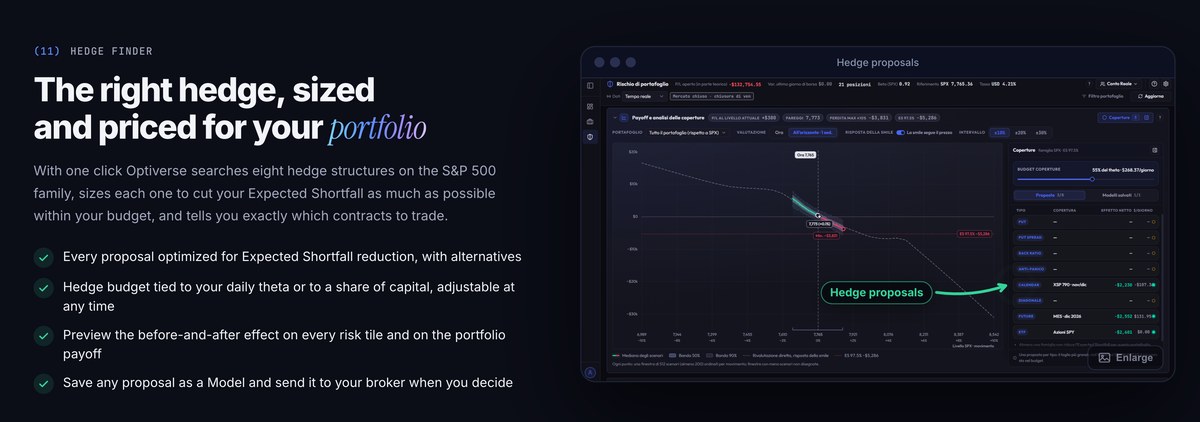
The second half of the video shows two Optiverse tools built for weeks like this one. The portfolio risk engine measures what your whole portfolio could lose in a major sell-off or volatility event. The Hedge Finder then searches hedge structures on the S&P 500 family and sizes each one to your budget, so you can see what a properly sized hedge would cost before you place it. Steve walks through how he uses it to think about a partial hedge on a long-term account.
New Optiverse customers can get 37 days of Premium with no credit card: Optiverse's 7-day trial plus 30 extra days with Steve's code. Optiverse is a tool, not a trading system: it shows you the trade and its risk, and the decisions stay yours. Get 37 days of Premium free.
Steve Ganz is under contract with Optiverse as a beta tester, launch partner and affiliate, and earns a commission when you subscribe with his code. You never pay more than buying direct from Optiverse.
The Alert Service Moves to Optiverse on January 1
Starting January 1, every trade in Steve's Alert Service will be placed in Optiverse, with a video explaining what he's doing and why, plus a share code so you can open the same trade in your own Optiverse. He'll also teach Optiverse inside the service. The video explains how joining now works ahead of the relaunch. See the Alert Service.
Next Week's Economic Calendar — November 23 to 27
Monday November 23 — S&P Global flash PMIs, 9:45 AM ET.
Tuesday November 24 — Conference Board consumer confidence, 10:00 AM ET. Dell reports after the close (date estimated), the first major AI-hardware report since Nvidia.
Wednesday November 25 — October PCE inflation and the second estimate of third-quarter GDP, 8:30 AM ET, along with jobless claims and durable goods. New home sales at 10:00 AM and the Fed's Beige Book at 2:00 PM. Deere reports.
Thursday November 26 — Thanksgiving. Markets closed.
Friday November 27 — Stocks close early, at 1:00 PM ET.
Key watch: Wednesday's PCE, the Fed's last inflation reading before its December 9 meeting. With a hike already 90–95% priced and two officials floating a half-point, a hot core reading raises the stakes while the AI leaders are breaking. A soft one strengthens the case that the bond market is pricing a slowdown.
30-Day Market Outlook
Overall bias: defensive, and short-term oversold. SPX is in a correction, below its 200-day average and below 7,000, and the Nasdaq is about 538 points from a bear market. Oversold markets bounce, and a bounce in a thin holiday week can be sharp. A bounce that fails under 7,000 would confirm the downtrend.
Macro narrative: The AI unwind has moved from a question about cash flow to a question about governance and accounting. Nvidia lost its CEO last week and drew a reported SEC accounting review this week, and the biggest IPO in history couldn't change the tape. Meanwhile the Fed is still leaning toward hikes while the bond market rallies, the Philadelphia Fed survey slumps and its price index jumps.
Primary risk: The AI selloff deepens. More detail on the Nvidia review, a weak Dell outlook on Tuesday, or Anthropic's lock-up expiring on December 15 could push the Nasdaq through 22,080 and SPX through 6,845.
Secondary risk: A hot PCE on Wednesday. A firm core reading puts a half-point hike in play with SPX already in a correction, and thin holiday trading can exaggerate the reaction.
What would change the read: A close back above 7,000, and then above Thursday's 7,175.83, would say Friday was a capitulation low rather than a breakdown. A close above the 200-day average near 7,350 would repair the trend. In the other direction, a close below 6,845.50 gives back 2026 for SPX, and a Nasdaq close below about 22,080 would be a bear market.
Educational content only, not financial advice. Options trading involves risk of loss, and past performance does not guarantee future results.